
Garages from one bay to three
Epoxy Garage Floors in Los Angeles, CA
A garage floor coating that bonds to clean concrete, hides old stains and stays put when the tires are hot.
- Free on-site estimates
- Slab moisture reading taken before we coat anything
- Written quote that lists the prep and every coat
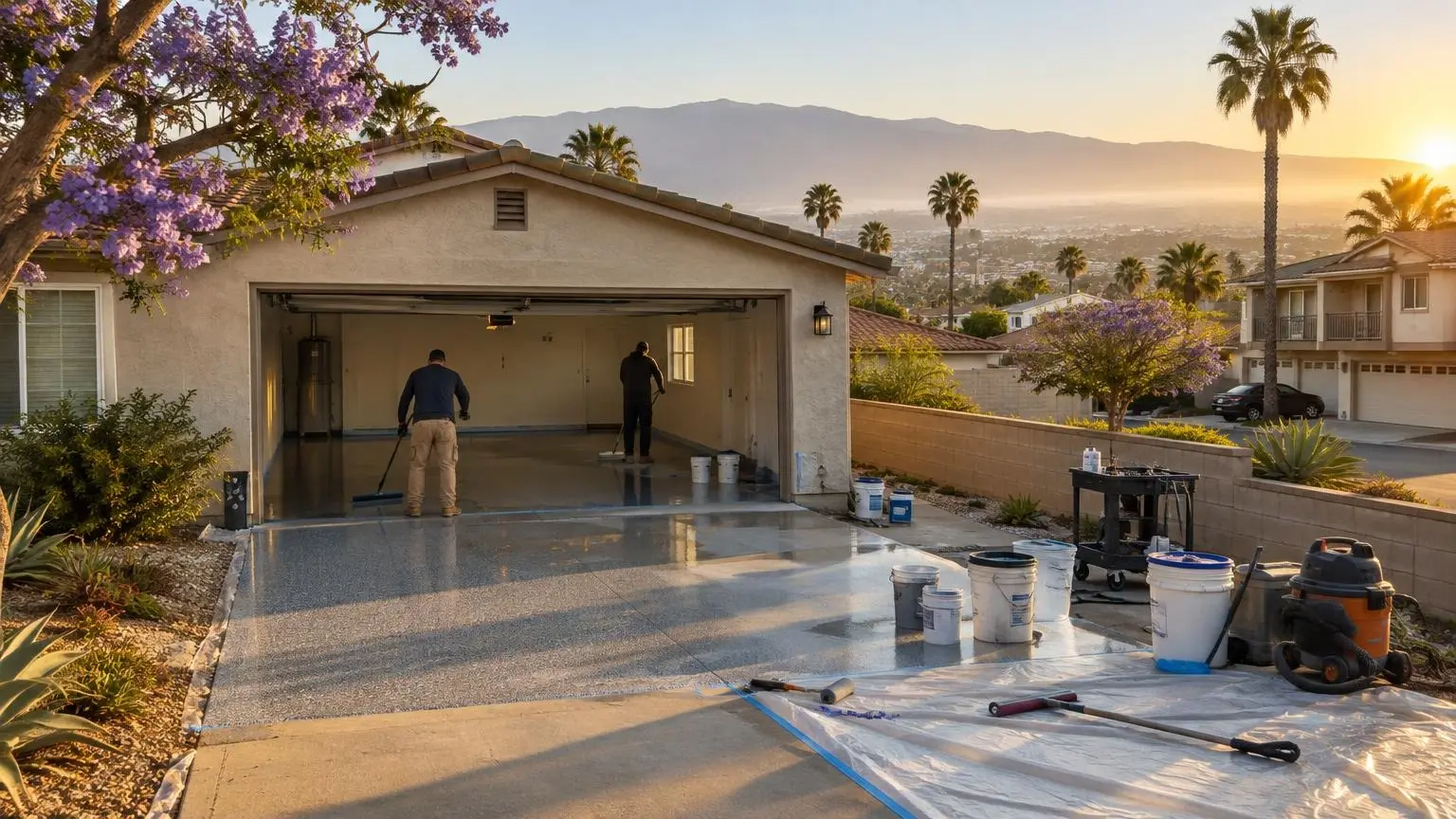
Garage Floor Epoxy for Los Angeles Homes
Epoxy garage floors account for more of our Los Angeles jobs than anything else. A good epoxy garage floor turns porous, dusty concrete into a sealed surface that sheds oil and water, brightens the room and is easy to sweep. In this city, a garage is often a gym, a workshop, a laundry room or storage for bikes and boards as much as a place to park, so the floor gets more foot traffic and more abuse than people expect. A garage floor coating is the simplest way to make that space feel finished.
Why bare garage concrete looks worse every year
Unsealed concrete drinks in whatever lands on it. Motor oil, brake fluid, coolant and tire marks sink in and leave dark patches that no cleaner fully lifts. The top layer keeps shedding a fine gray dust that ends up on everything stored in the garage. In older garages there is often paint or a store-kit coating on top that has already started peeling where the tires turn. Each of those is something we deal with before any color goes down.
Signs your garage is ready for a coating
- Oil or fluid spots sunk deep into the concrete
- Concrete dust that comes back after you sweep
- Paint or an old kit coating flaking in the tire paths
- Hairline or shrinkage cracks, chipped joints or rough patches
- A dull, rough strip by the door where weather and sun hit
- A floor you are about to cover with a gym, cabinets or a workshop and would rather finish first
Sun through the door and hot tires
Wikipedia credits downtown Los Angeles with about 3,254 hours of sunshine a year, and a garage that faces west with its door open soaks up a good share. Plain epoxy earns just a poor-to-fair UV rating in HomeGuide's guide, so the patch of floor the sun lands on can yellow over time. That is why our garage floor epoxy gets a UV-stable polyaspartic topcoat. The other frequent failure is hot tire pickup: tires warmed on hot pavement soften a thin coating and can tear it loose as they cool overnight. In the Valley, where heat waves are common in September and October, that risk is real. A thicker system on diamond-ground concrete with a hard topcoat keeps the coating where it belongs.
Cracks, joints and old slabs
A lot of Los Angeles garages were poured during the postwar growth of the 1950s and 1960s, and the region's earthquakes have added to the normal shrinkage cracking. During the estimate we look at every crack. Hairline cracks that are not moving get routed or ground open and filled flush with a repair material, so they disappear under the coating. A crack with a lip, or one that has clearly widened, is a sign of movement. We will point it out and suggest getting it checked before you coat over it, because a coating will crack right along with the slab. Control joints are either filled or kept open as working joints, depending on the slab, and we explain the choice.
Moisture testing is not optional
Most of the rain here falls between November and March, and in summer a garage can feel bone dry. The slab may still be wicking moisture up from the ground, particularly with sprinklers or planter beds running along the outside wall. That vapor presses on the coating from underneath and is a leading cause of blisters and bubbles. We test the slab during the estimate. If the reading is elevated, we apply a primer made to handle damp concrete, or we tell you the slab needs more time before coating.
Prep is most of the job
Store-bought kits depend on acid etching, which freshens the top layer yet leaves weak concrete, old sealers and oil behind. We diamond grind the entire garage, including the edges along the walls, then vacuum the dust, degrease any oil spots and repair cracks and chips. Only then do the base coat, the color or flake layer and the topcoat go down. Most failures we are asked to fix trace back to skipped prep, not to a bad product.
Garages that are more than parking
If the garage is a gym, put the coating down before the rubber mats and racks go in, and tell us where heavy equipment will sit so we can plan a thicker build there. For a workshop, a lighter color makes dropped screws and small parts easier to find and brightens the room. If the washer and dryer live in the garage, we coat behind and under where they stand, and we leave a clean edge at the floor drain if there is one. For storage of surfboards, bikes or camping gear, a full flake hides the sand and grit those bring home. Planning around how you use the space now saves moving things twice.
Picking a look
Most owners go with a full flake broadcast, since it disguises dust and tire marks and gives better footing. For a cleaner workshop feel, pick a solid color, then add either a sprinkle of flake or anti-slip grit. Either way, the wear lands on the clear topcoat. We bring samples so you can judge them under your own garage lighting, which rarely matches a photo.
What a Garage Coating Includes
We coat the entire slab, threshold to back wall, plus any steps you want done.
Diamond grinding
Grinding across the whole floor and along its edges to strip paint, sealer, oil residue and weak surface concrete.
Crack and joint repair
Static cracks, chips and spalls filled flush; control joints filled or kept as working joints.
Moisture-tolerant primer
Used when the slab moisture test reads high, so vapor does not lift the coating.
Base, color and topcoat
A bonded epoxy or polyaspartic base, then flake or a solid color, finished in a clear, UV-stable topcoat.
Old coating removal
Failing paint or old kit epoxy is ground away so the new system has bare concrete to bond to.
Steps and curbs
Coating extended onto garage steps and the short concrete curb at the wall base, if you want it.
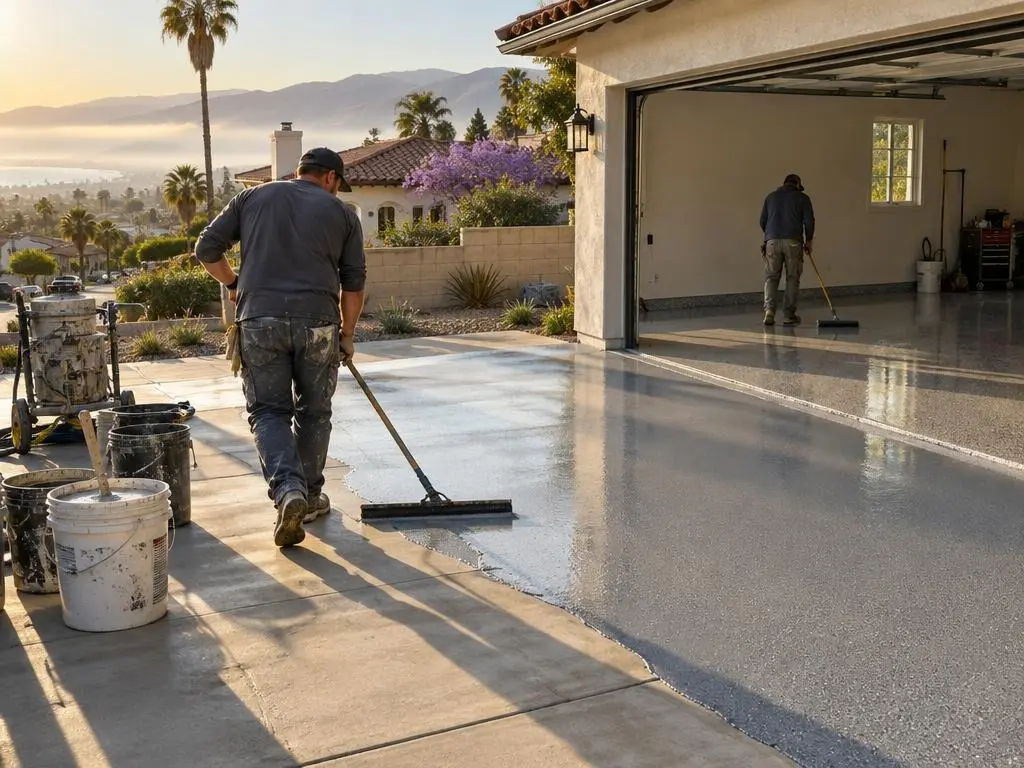
Typical Epoxy Garage Floor Costs
| Job | Published range | Source |
|---|---|---|
| Installed epoxy, per sq ft | $4 to $10 | HomeGuide |
| One-car garage, epoxy | $1,200 to $3,900 | HomeGuide |
| Two-car garage, epoxy | $1,600 to $5,800 | HomeGuide |
| Three-car garage, epoxy | $2,300 to $8,600 | HomeGuide |
| Polyurea garage coating, per sq ft | $5 to $10 | HomeGuide |
| Crack and chip patching | $25 to $250 | This Old House |
These figures are national, taken from HomeGuide's epoxy and garage floor coating guides and from This Old House. A Los Angeles job moves with slab size, old coatings that must come off, crack repair and your chosen finish. We measure and test first, and the written estimate is the amount you pay.
How a Garage Floor Job Goes
1. Estimate and moisture test
We size up the garage, take a slab moisture reading and record cracks, stains and earlier coatings.
2. Written quote
You get the system, the coats, the prep, the crack repair and the total in writing.
3. Grind and repair
We diamond grind and vacuum the floor, degrease oily spots and patch cracks and chips.
4. Coat
Base coat, flake or color, then a UV-stable topcoat, each applied after checking slab temperature and dew point.
5. Cure and hand back
You get walk-on, move-back and parking times that reflect the product used and the conditions that day.
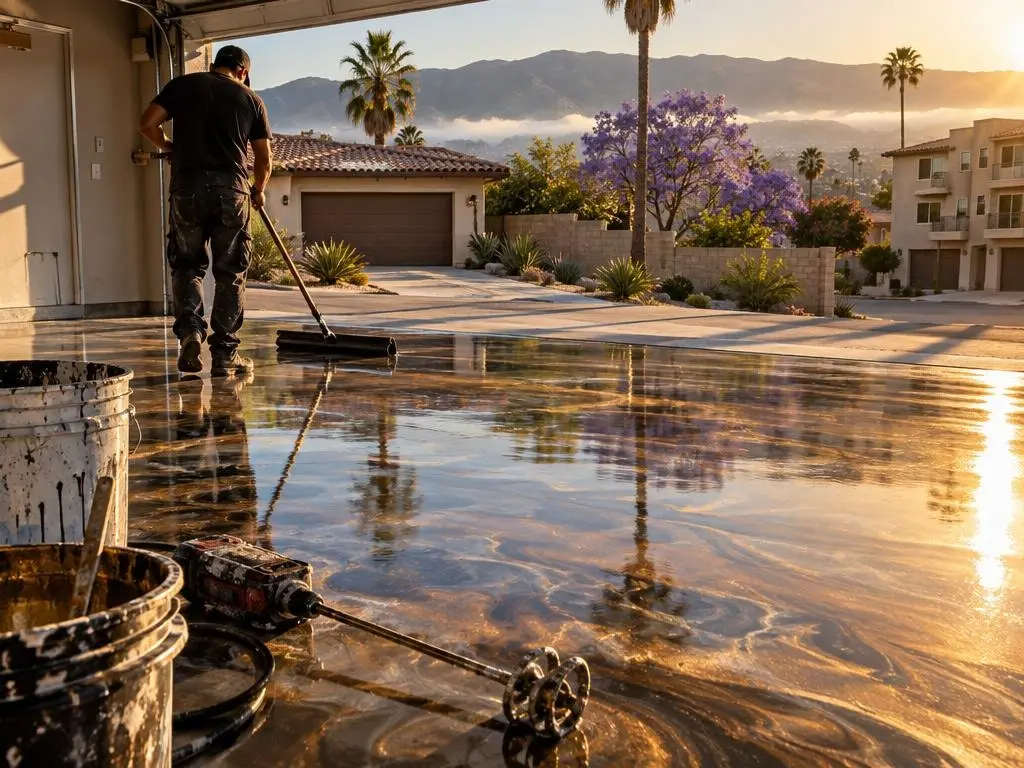
Why Choose Us for Epoxy Garage Floors
Full grind, edge to edge
We grind along the walls and into the corners, where kit coatings usually start to peel.
Honest crack calls
We tell you which cracks we can repair and which ones need a look before any coating.
Topcoats for open-door garages
Sun-exposed floors are finished with a UV-stable topcoat to keep their color.
Epoxy Garage Floors Questions
What lifespan can I expect from an epoxy garage floor?
HomeGuide puts a solid epoxy floor at roughly 10 to 20 years and thin water-based kits at 3 to 5 years. Prep, moisture, sun exposure and how hard the garage is used decide where a floor lands in that range.
Why do DIY garage kits peel?
Most kits rely on acid etching and a thin coat. That leaves old sealer, oil and weak concrete under the coating, and hot tires can lift it. Diamond grinding plus a thicker build under a hard topcoat fixes most of that.
When can I park in the garage again?
HomeGuide advises keeping cars off a new epoxy floor for 2 to 7 days. A polyaspartic system can take vehicles in about 24 to 48 hours. On install day you get specific times for your own floor.
Is it possible to coat over old paint on my garage floor?
Not directly. Paint and kit coatings get ground off first, since a new coating can bond no better than the surface beneath it.
Is a coated garage floor slippery?
A smooth, glossy floor can be slick when wet. Flake broadcast, or anti-slip grit mixed into the topcoat, improves traction, and we suggest it for garages with wet shoes or car drips.
Epoxy Garage Floors Service Areas
- Epoxy Flooring in Los Angeles, CA
- Epoxy Flooring in Pasadena, CA
- Epoxy Flooring in Glendale, CA
- Epoxy Flooring in Burbank, CA
- Epoxy Flooring in Santa Monica, CA
- Epoxy Flooring in Culver City, CA
- Epoxy Flooring in Beverly Hills, CA
- Epoxy Flooring in Torrance, CA
- Epoxy Flooring in Long Beach, CA
- Epoxy Flooring in Inglewood, CA
- Epoxy Flooring in Downey, CA
- Epoxy Flooring in Whittier, CA
- Epoxy Flooring in Alhambra, CA
- Epoxy Flooring in Arcadia, CA
- Epoxy Flooring in Monrovia, CA
- Epoxy Flooring in West Covina, CA
- Epoxy Flooring in Santa Clarita, CA
- Epoxy Flooring in Calabasas, CA
- Epoxy Flooring in Redondo Beach, CA
- Epoxy Flooring in Manhattan Beach, CA
- Epoxy Flooring in Hawthorne, CA
- Epoxy Flooring in Carson, CA
- Epoxy Flooring in Gardena, CA
- Epoxy Flooring in Lakewood, CA
- Epoxy Flooring in South Gate, CA
Get an Epoxy Garage Floors Estimate
Get a free on-site estimate and moisture test for your garage.